
Outdoor living
16 September 2026
6 min read
Alfresco cabinetry in Perth: what must be different outdoors
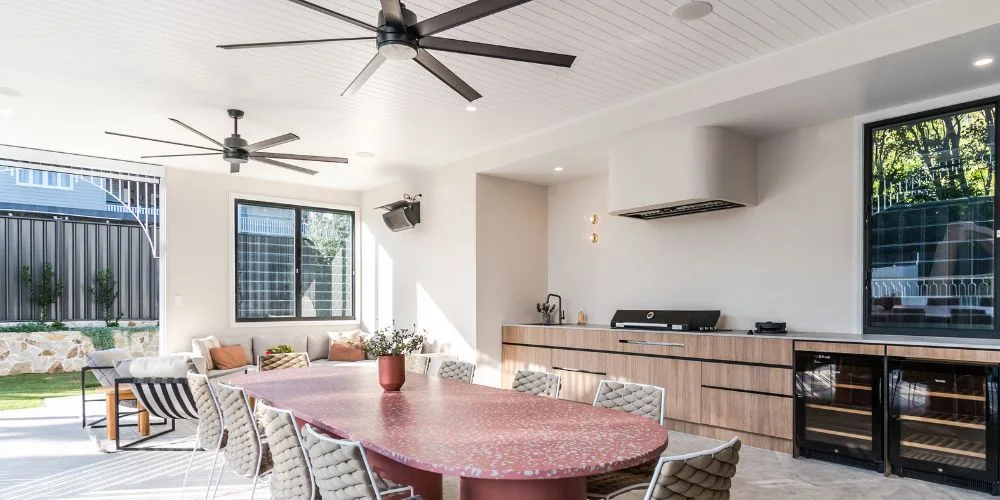
An outdoor kitchen is not an indoor kitchen moved outside. Perth sun, salt air and wind-driven rain destroy ordinary cabinetry in a couple of summers. Here is what has to change — materials, hardware, benchtops and layout — for alfresco cabinets that last.
Perth's outdoor conditions, specifically
Three things wreck outdoor cabinetry here. The first is ultraviolet light: a Perth summer delivers some of the strongest UV in the world, and it chalks paint, yellows resins and makes standard laminates brittle. The second is salt. Anywhere from Cottesloe to Rockingham and Mandurah, sea air carries salt inland, and it corrodes ordinary steel hinges and screws within a season. The third is water where you did not expect it — a Fremantle Doctor driving rain a metre under a roof, or hosing down the alfresco floor.
The result is that an indoor cabinet outdoors fails quickly at the edges, the hinges and the kickboard, in roughly that order. Good alfresco cabinetry is designed backwards from those three failures.
Materials that survive outside
- Compact (solid-core) laminate. Dense, through-coloured laminate panels that need no edging and shrug off water. The most common choice for covered Perth alfrescos.
- Powder-coated marine-grade aluminium. Doesn't rot, rust or swell; ideal near the coast. Choose a textured or matte powder coat to hide fingerprints.
- Marine-grade polymer (HDPE). The material of boat cabinetry — fully waterproof, UV-stable, colourfast. Limited colours, excellent longevity.
- 316 stainless steel. The right grade for salt air (304 will tea-stain near the ocean). Hygienic and heat-proof; shows scratches.
- Exterior-rated timber or accoya. Beautiful under a deep roof, needs oiling, and should be kept out of direct weather.
What does not belong outdoors: standard or moisture-resistant particleboard, MDF, vinyl-wrap doors and ordinary two-pac. Even under a roof, humidity and temperature swings will find them.
Hardware: where cheap outdoor kitchens fail first
Every hinge, runner, screw and handle should be stainless steel — 316 grade if you are within a few kilometres of the coast — or a hardware maker's dedicated outdoor range. Standard zinc-plated soft-close hinges look identical on day one and seize within two years. Drawer runners are the most exposed component because they sit low, near hosed floors; choose sealed stainless runners or design the storage as doors and shelves where runners are hard to protect.
Benchtops and splashbacks for outdoors
The benchtop takes the sun, the heat of the barbecue and the rain. Porcelain and sintered stone are the best outdoor surfaces available: UV-stable, heat-proof, non-porous, and available in large slabs. Granite is the natural-stone alternative and needs periodic sealing. Stainless steel suits a serious cook. Avoid anything with resin — including the mineral surfaces that replaced engineered stone indoors — and avoid laminate benchtops entirely.
Splashbacks follow the same logic: porcelain, tile or stainless. Glass splashbacks work but show salt residue quickly near the ocean.
Layout: barbecue, fridge, sink and clearances
- Barbecue. Built-in barbecues need the manufacturer's clearance to combustible surfaces and a ventilated cabinet if gas is bottled underneath. We design the cabinet to the specific model, so choose the barbecue before the cabinetry is drawn.
- Fridge. Only an outdoor-rated fridge belongs in an alfresco cabinet; indoor bar fridges overheat. It needs front ventilation and a shaded position.
- Sink. Worth it if you will actually rinse and wash out there; otherwise it adds plumbing and a drain for the sake of it.
- Kickboards and drainage. Raise cabinets on adjustable legs, use a recessed aluminium or compact-laminate kick, and make sure the floor drains away from the cabinet run.
- Cover. The single biggest factor in lifespan. Cabinetry fully under a roof lasts multiples longer than cabinetry that takes direct rain and sun.
Looking after it
Rinse salt off surfaces and hardware with fresh water every few weeks in summer if you live near the coast, wipe benchtops after cooking, and keep the barbecue clean so grease does not bake onto adjacent panels. Once a year, check hinge screws and re-oil any timber. Our cabinetry care guide covers the indoor side. For a longer read on outdoor materials and construction, see the outdoor kitchens guide.
Common questions
Can normal kitchen cabinets be used outside under a patio?
No. Even under a roof, particleboard, MDF and vinyl-wrap doors swell, delaminate and fade within a few Perth summers. Use compact laminate, marine-grade aluminium, HDPE or 316 stainless, with stainless hardware.
What is the best benchtop for an outdoor kitchen in Perth?
Porcelain or sintered stone first, then granite or stainless steel. All are UV-stable and heat-proof. Avoid laminate and any resin-based surface.
Do outdoor cabinets need stainless hinges?
Yes. Use 316 stainless or a dedicated outdoor hardware range, especially within a few kilometres of the coast. Standard zinc-plated hinges corrode and seize.
Do you build alfresco cabinetry in Rockingham and Mandurah?
Yes. Coastal suburbs are where outdoor cabinetry is most demanding, and we specify materials and hardware for salt air accordingly. In-home consultations are free.
Related
Sources & further reading
Information checked 16 September 2026. Product, safety and regulatory requirements can change; confirm current details for your project.